
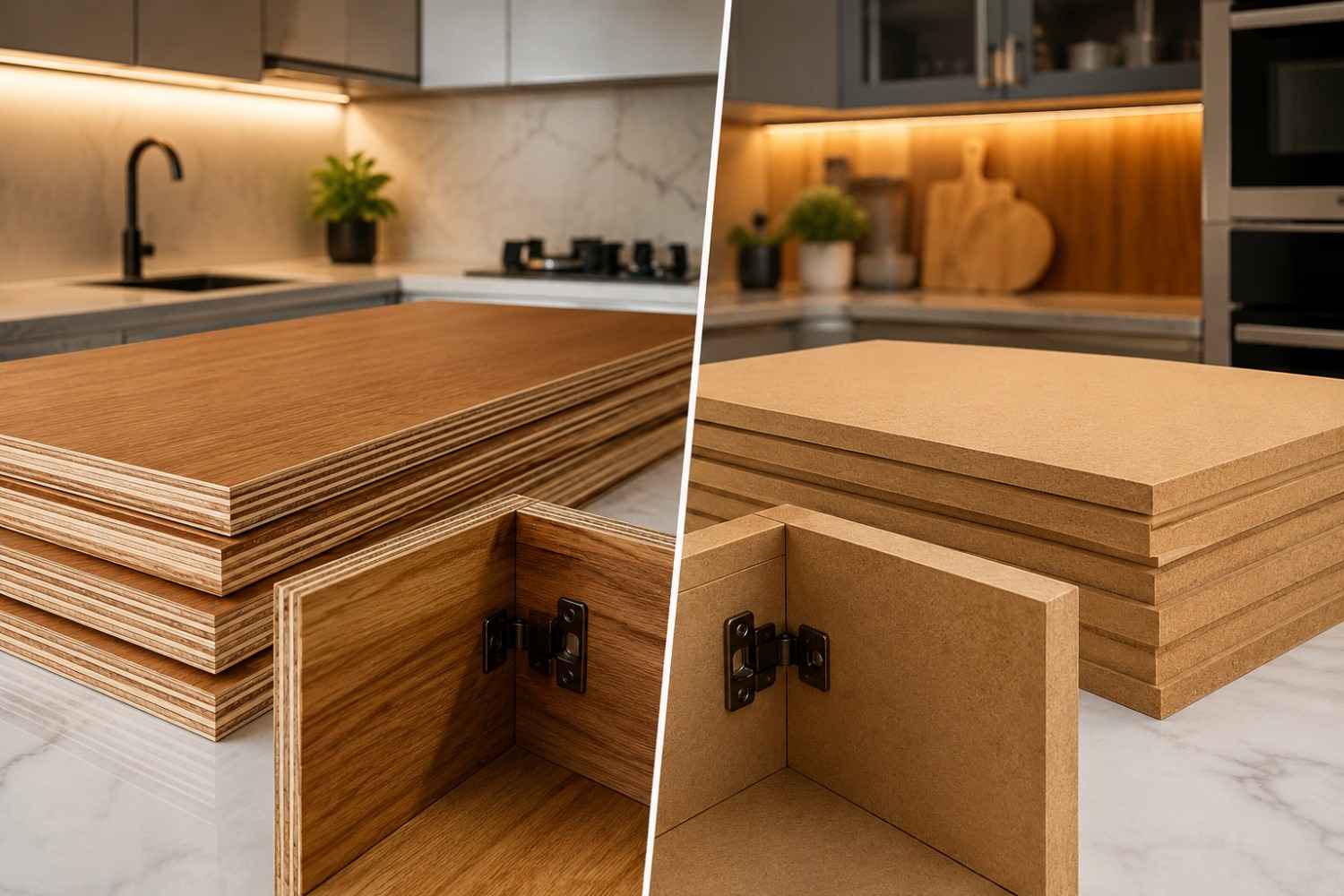
Building or renovating a kitchen is one of the most rewarding investments you can make for your home. But as you dive into cabinet designs, layout choices, and color palettes, you are inevitably faced with a core structural question: Marine Plywood vs MDF—which material is truly best for your kitchen cabinets?
Making the right material selection ensures your kitchen isn't just visually stunning on day one, but also survives years of daily cooking, steam, spills, and heavy storage. At BALDIA INTERIOR INDIA PRIVATE LIMITED, we believe that educated homeowners make the best design choices. Let’s break down how Marine Plywood and MDF stack up against each other so you can choose the ideal backbone for your dream kitchen.
Understanding the Contenders: Marine Plywood vs MDF
To pick the right material, it helps to understand how each panel is manufactured and how it behaves under daily wear and tear.
What is Marine Plywood?
Marine Plywood is a top-tier structural timber panel crafted by cross-laminating multiple thin layers of wood veneers using waterproof adhesives like phenolic resin. Because it is originally engineered to withstand marine environments and constant water immersion, it boasts extraordinary structural strength, exceptional screw-holding power, and high resistance to boiling water, moisture, and fungal decay.
What is Medium-Density Fibreboard (MDF)?
MDF is produced by breaking down hardwood or softwood residuals into fine wood fibers, combining them with wax and resin binders, and compressing them under intense heat and pressure. The result is a smooth, uniform, grain-free sheet. While Moisture-Resistant MDF (MR MDF) is treated to handle ambient humidity, standard MDF behaves like a sponge when exposed to standing water, expanding and losing structural integrity once wet.
The Ultimate Head-to-Head Comparison
1. Water & Moisture Resistance
Kitchens are high-moisture zones. From dishwashing splatters near the sink to steam rising off cooking pots, your cabinet carcasses are constantly tested.
- Marine Plywood: Takes the crown here. Its waterproof resin bonding ensures that even if liquid penetrates the surface, the core won't swell or delaminate. It is essential for base cabinets, sink units, and under-counter storage.
- MDF: Offers limited defense. While MR MDF handles light humidity well, standard MDF swells irreversibly if water seeps into joints or edges.
2. Load-Bearing Strength & Durability
Think about heavy cast-iron cookware, stacks of ceramic dinnerware, and heavy pantry items.
- Marine Plywood: Its alternating cross-grain pattern gives it massive tensile and load-bearing strength. Shelves won't sag over time, and fasteners hold tight even after years of opening and closing heavy doors.
- MDF: Being composed of fine fibers rather than solid wood layers, long MDF shelves are prone to sagging under heavy weight. Screw holes can also strip or crumble if doors are slammed repeatedly.
3. Surface Finish & Aesthetics
- MDF: This is where MDF shines. Its smooth, poreless, grain-free surface makes it the absolute best choice for intricate CNC router routing, painted shaker doors, and flawless high-gloss acrylic or lacquer finishes.
- Marine Plywood: Has natural wood grain textures. While wonderful for wood veneers and laminates, achieving a glass-smooth direct paint finish requires extensive sanding and priming compared to MDF.
Matching Materials to Your Ideal Modular Kitchen Layout
Whether you are designing a sleek German Modular Kitchen, an elegant Italian Kitchen, or a crisp modern Modular Kitchen, the layout you pick heavily influences where each material should go.
Here is how top Modular Kitchen Manufacturers like BALDIA INTERIOR INDIA PRIVATE LIMITED engineer different layouts:
- L-Shaped Kitchen & U-Shaped Kitchen: These popular layouts feature deep corner spaces and continuous counter runs. Using Marine Plywood for all base cabinetry ensures that corner units support heavy granite or quartz countertops without buckling.
- Parallel Modular Kitchen & Inline Modular Kitchen: Perfect for narrow spaces or compact homes. Using Marine Plywood near the wet sink counter and stove zone guarantees longevity, while MDF can be strategically used for upper wall units to keep costs down.
- Island Kitchen & G-Shaped Kitchen: These sprawling layouts serve as social hubs. An island host sink or cooktop requires a Marine Plywood core to resist daily spills, while decorative outer paneling can feature routed MDF for intricate architectural details.
The Winning Hybrid Strategy
Why choose just one when you can harness the strengths of both? Premier turnkey experts at BALDIA INTERIOR INDIA PRIVATE LIMITED frequently recommend a smart hybrid approach:
- Use Marine Plywood for Cabinet Carcasses & Base Units: Keep your cabinet boxes, sink units, and heavy drawer modules rock-solid and 100% water-protected.
- Use MDF for Front Shutters & Decorative Elements: Enjoy flawless painted profiles, seamless routed grooves, and cost efficiency on visible cabinet doors and upper wall trim.
Frequently Asked Questions (FAQs)
Is Marine Plywood necessary for all kitchen cabinets?
Not always for the entire kitchen, but it is highly recommended for base cabinets, sink modules, and areas near dishwashers where direct water spills occur. Upper wall units in dry areas can safely use MR MDF or commercial ply.
Can MDF be used for kitchen cabinet doors?
Yes! In fact, MDF is often superior to plywood for cabinet shutter doors because its smooth surface takes paint, acrylic, and PVC membrane coatings without revealing wood grain or warping.
How does BALDIA INTERIOR INDIA PRIVATE LIMITED ensure quality cabinet construction?
At BALDIA INTERIOR INDIA PRIVATE LIMITED, we combine high-precision factory machinery with premium materials. We select factory-certified BWP Marine Plywood for moist structural zones and high-density MR MDF for decorative finishes, delivering a long-lasting, beautifully tailored kitchen.
Recent Post


Space Saving L Shaped and U Shaped Kitchen Designs
14 Oct, 2026
How to Make a Small Kitchen Look Bigger
07 Oct, 2026
Custum Modular Wardrobe Designer in Delhi NCR
22 Sep, 2026
Wall Mounted vs Floor Mounted Bathroom Vanity
15 Sep, 2026
Best UPVC Window Manufacturer in Delhi
09 Sep, 2026
How to Choose the Perfect Wardrobe for Your Bedroom
03 Sep, 2026


Custom Kitchen Manufacturers in Dwarka Sector 14
25 Jul, 2026
Marine Plywood vs MDF for Kitchen Cabinets
21 Jul, 2026
Statement Kitchens That Make Every Home Look Premium
17 Jul, 2026


Affordable Modular Kitchen Solutions in Dwarka
08 Jul, 2026


Modern G Shaped Kitchen Design Trends
01 Jun, 2026
Home Renovation Services for Modern Homes in Delhi
01 Jun, 2026


Sliding vs Openable Shutters Which Wardrobe Style
23 May, 2026
.webp "Parallel Modular Kitchen Designs for Stylish Urban Homes")
.webp "Modern Italian Kitchen Ideas for Small Spaces in India")
.webp "German Modular Kitchen Designs for Indian Homes")
German Modular Kitchen Designs for Indian Homes
02 May, 2026.webp "Best Island Kitchen Colour Combinations and Designs for Modern Homes")
.webp "Hiring an Interior Contractor Is the Smartest Choice for Your Home")
.webp "Sliding Door Wardrobe Ideas for a Modern Minimal Home")
.webp "Design a Walk In Closet in a Small Bedroom")
Design a Walk In Closet in a Small Bedroom
15 Apr, 2026.webp "10 Stunning Modular Kitchen Ideas That Will Blow Your Mind")
.webp "U Shaped Kitchen Ideas for Small & Big Homes")
.webp "L Shaped Kitchens Are the Ultimate Choice for Smart Living")
